
-
 Dave Schwartz
469In the most recent video, which is publicly available (for now), I showed how all handicapping basically comes down to a HANDFUL OF COLUMNS.
Dave Schwartz
469In the most recent video, which is publicly available (for now), I showed how all handicapping basically comes down to a HANDFUL OF COLUMNS.
I asked the question, "Which columns do you have the greatest belief in?"
A couple of people asked me questions that sounded a lot like, "What are you talking about? I don't actually have ANY columns because I don't use reports."
CLARITY: WHAT'S A COLUMN?
Imagine that you have personal names for FACTORS that most of us could identify easily.
ES as running style - many use a "column" called Quirin ES Points for that, while others use the old Fred Davis approach, or some home-grown creation.
If you HAVE a "sheet" of some kind, that would be one of your columns.
As a further example, when I use the word "SPEED" I mean "speed ratings," but many people automatically connect that to "EARLY SPEED."
Doesn't really matter... I see them... whatever we call them... they are all columns in SOMEONE'S data.
CLARITY: DIFFERENCE BETWEEN COLUMNS & FACTORS
... or... When does a Single Factor become a COLUMN or vice versa?
Consider the PSR rating. (Projected Speed Rating, a proprietary HDW rating that is kin to BRIS Prime Power. (Not the same under the hood, but like the same horses very often.)
That "factor" called PSR is in our system as Factor #174 (rank for PSR). It's hit rate on rank=1 is ~31%.
(For those unaware, DET currently has about 3,200 factors for each horse.)
So, think of PSR as a COLUMN.
Thus, it can be both a COLUMN & a FACTOR.
CLARITY: HANDICAPPING OBJECTS
A Handicapping Object is a handicapping construct with up to 5 factors.
Each factor has a weight controlled by the user.
Thus:
Handicapping Object = (up to) 5 factors.
Because you can fire an OBJECT and see the results in... wait for it... a SORTABLE COLUMN...
... It can also be one of YOUR COLUMNS.
CLARITY: COLUMNS to FACTORS to OBJECTS TO COLUMNS
Imagine the PENELOPE CONSENSUS PAGE.
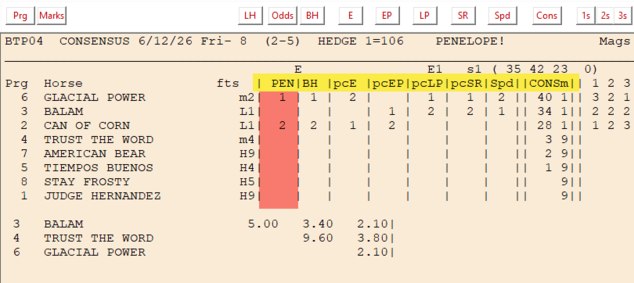
Each of these AI-based columns are made up of 30 factors chosen by the AI engine specifically for this TYPE OF RACE (based upon how the AI sees "race type.")
(special note: there are 40,000 race type permutations.)
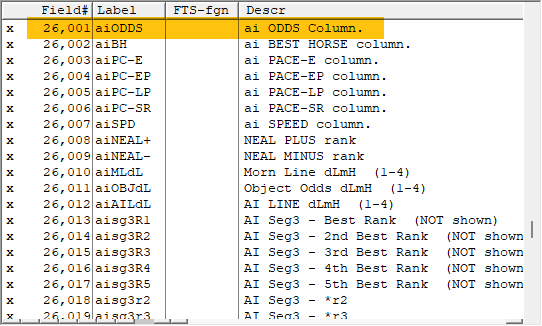
Consider just the PEN column...
The ranks for that column are available as a single factor.
CLARITY: REAL POWER OBJECTS
If you considering that you can put FIVE factors into an OBJECT...
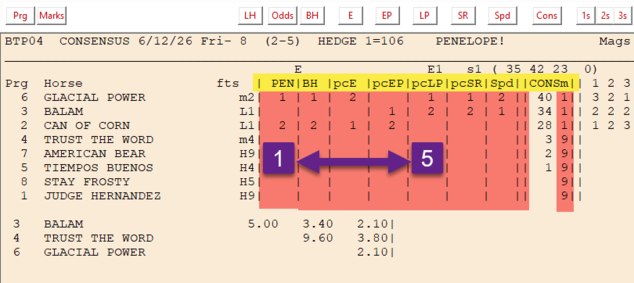
... you can effectively put 5 x 30 = 150 factors into ONE OBJECT.
Not just any factors... but the 150 factors (also known as COLUMNS) into a single object.
Next, recall that there exists a simple box that allows you to FIRE TWO OBJECTS TOGETHER AS ONE, you can actually use *300-AI-chosen factors.
SOME NOTES
*There are factors used across multiple columns.
___________________
*When you REMOVE a horse from the screen his ranks are recovered.
(This is where Brian's idea of race-within-a-race, race-within-a-race, race-within-a-race came from.)
(Otherwise known as "Search the current contenders for the 88%.)
(Quite a brilliant idea, actually.)
@ponyplayer
___________________
*Did you know that the whale teams typically use between 150 and 175 factors maximum? -
 Andrew Kramer
20I use about 5 columns in my predictive models (different columns for the models). The best seem to be the morning line (duh), AB, the Neal, pcrH, and Rey4. Are other DET people seeing similar or different results?
Andrew Kramer
20I use about 5 columns in my predictive models (different columns for the models). The best seem to be the morning line (duh), AB, the Neal, pcrH, and Rey4. Are other DET people seeing similar or different results? -
 Jim Pommier
203I had a call with Dave yesterday to go over this. Rather than trying to decide on the factors myself-- I decided to test letting the 26,000 AI-based columns made up of 30 factors chosen by the AI engine specifically for this TYPE OF RACE (based upon how the AI sees "race type.") do the work for me. 150 factors (also known as COLUMNS) in one object.
Jim Pommier
203I had a call with Dave yesterday to go over this. Rather than trying to decide on the factors myself-- I decided to test letting the 26,000 AI-based columns made up of 30 factors chosen by the AI engine specifically for this TYPE OF RACE (based upon how the AI sees "race type.") do the work for me. 150 factors (also known as COLUMNS) in one object.
Dirt/Tapeta races from Saturday and Monday. No Turf, no races with FTS's, no races with two d1's, two L1's or a d1/L1, or races where a H9 is the top selection.
32 races = $64.00. Return = $139.94. ROI = 118.65%. There was actually a d1 $25.00 winner that I left out since I haven't seen that high of a payoff on a d1.
You may want to look at the 26,000 columns and see how they work with your columns and also integrate with the 88% - Finding the Race Within the Race. -
Andrew Kramer
20Jim,
I'm impressed. That's an unheard-of ROI. Good job.
My research looks at ~3,000 races, splitting them into development (where the model is created), test (seeing if the development model is for real or a fluke), and validation (seeing if the model fades after a month) data sets. I've been creating predictive models for 25 years (mostly in the medical field), and I've learned that all models definitely have a "shelf life" . This should be the case for horse racing, where tracks, purses, weather conditions, etc... change frequently,
So you may have found the golden bullet (killing off whales). But my experience tells me that most models (or at least, the ones I've created) don't persist. -
 Jeff Capper
52Hi Andrew, I like the same columns that you do, but I also add abRX and abRy. I've been looking at them individually and doing a union as a contender selector. So my question for the group would be: if I were to build an object consisting of abPACE BH, pcrH, abRX, abRY and PEN- would that be duplicative of an object that already exists?
Jeff Capper
52Hi Andrew, I like the same columns that you do, but I also add abRX and abRy. I've been looking at them individually and doing a union as a contender selector. So my question for the group would be: if I were to build an object consisting of abPACE BH, pcrH, abRX, abRY and PEN- would that be duplicative of an object that already exists? -
Andrew Kramer
20Jeff,
Aren't abRx and abRy highly correlated? Also, what do you mean by "doing as union"?
Thanks!!!
Andrew -
 Rick Irvin
20are there factor numbers for abPace, perhaps, abRX, Abruzzo, and Pen that we can put into an object? If so, I would be willing to build an object to test how it performs
Rick Irvin
20are there factor numbers for abPace, perhaps, abRX, Abruzzo, and Pen that we can put into an object? If so, I would be willing to build an object to test how it performs -
Dave Schwartz
469↪Jeff Capper are there factor numbers for abPace, perhaps, abRX, Abruzzo, and Pen that we can put into an object? If so, I would be willing to build an object to test how it performs — Rick Irvin
No.
Sorry. -
Rick Irvin
20I didn’t think that those factors were available. Just wanted to make sure I wasn’t missing something. For what it is worth, I’m finding that the seg3 r2 and r3 are powerful.
-
Dave Schwartz
469I didn’t think that those factors were available. Just wanted to make sure I wasn’t missing something. For what it is worth, I’m finding that the seg3 r2 and r3 are powerful. — Rick Irvin
All of those are available as factors - a in some very creative ways. -
Jeff Capper
52let's say abRX gives me 1,2 and 4 as contenders and abRYgives me 1,2,4 and 5. By union means I'm considering 1,2,4 and 5 as contenders. Whereas intersection would give me 1,2 and 4. Union casts a wider net than intersection.
-
Jim Pommier
203Several nice winners yesterday using the the 26,000 AI-based columns made up of 30 factors chosen by the AI engine specifically for the TYPE OF RACE (based upon how the AI sees "race type."). 150 factors (also known as COLUMNS) in one object.
GPX01 - #3 $18.80
GPX03 - #4 $8.80
GPX05 - #9 $5.40
GPX06 - #5 $9.80
ELP01 - #6 $13.26
ELP05 - #10 $6.80
ELP07 - #8 $22.72
ELP08 - #8 $11.48
TDN01 - #3 $6.20
TDN03 - #4 $7.00
TDN08 - #4 $4.60
Plus 8 Exactas using the TOP 3 contenders. Two more exactas if you went 4 deep.
Rules: No Turf races, no races with FTS's, no races with two d1's or two L1's or a d1/L1. -
Rick Irvin
20Just curious. How did you weight your factors? Fib OU, equal, something else? I don’t want you to give away your factors
-
Jim Pommier
203That's okay. Here's the setup: 26,003 - 26,003 - 26,004 - 26,007 - 26,001. (E - E - EP - SPD - ODDS). Standard Fib. Since I'm only using this object-column for dirt races, it leans heavy on early speed. I prefer contenders that are going to be on or near the lead. I think this may also work for Turf sprints. This is similar to the object-column "Obj01", but I added SPD and ODDS.
-
Dave Schwartz
469Several nice winners yesterday using the the 26,000 AI-based columns made up of 30 factors chosen by the AI engine specifically for the TYPE OF RACE (based upon how the AI sees "race type."). 150 factors (also known as COLUMNS) in one object.
GPX01 - #3 $18.80
GPX03 - #4 $8.80
GPX05 - #9 $5.40
GPX06 - #5 $9.80
ELP01 - #6 $13.26
ELP05 - #10 $6.80
ELP07 - #8 $22.72
ELP08 - #8 $11.48
TDN01 - #3 $6.20
TDN03 - #4 $7.00
TDN08 - #4 $4.60
Plus 8 Exactas using the TOP 3 contenders. Two more exactas if you went 4 deep.
Rules: No Turf races, no races with FTS's, no races with two d1's or two L1's or a d1/L1. — Jim Pommier
Jim learned this in private sessions. (Free)
You guys really are missing it.


Please register to see more
Forum Members always see the latest updates and news first. Sign up today.