
Comments
-
HSH: Using PaceOf course the low odds horses are the favorites I'm mentioning......
Does HSH have any proprietary factors to combat this? — HorseSense
Not so much proprietary , but of course.
We build OBJECTS - which are from 1 to 6 factors weighted together. -
HSH: Using PaceActually, you've described the basis of my handicapping - although for me it all begins with the low odds horses.
-
HSH: Using PaceWith this complicated software , your resorting to PSR with Early and Late? — HorseSense
The game is more difficult than ever and I have no interest in playing without long-term profitability.
I'm always ready to be taught something - simple or complicated - that allows me to continue to win.
Do you have anything to offer? -
Bet against spot plays?I don't know anything about Pickmaster, but, as Dave said, it takes a lot of factors to have consistent eliminations or inclusions. And, sometimes I use composite data. — RanchWest
Actually, ultimately, it boils down to a few meaningful objects with the right application.
Still the game isn't easy. -
Bet against spot plays?Have you tried searching for these scenarios through Pickmaster? If so, do you believe it would be a worthwhile endeavour? — Tony Kofalt
Yes, that is one of the tools.
We also have one called the OBJECT MASTER that allows you to turn on as many as 300 factors and optimize and object using a pretty cool approach.
Imagine 300^4 = 8.1 billion permutations - searching for the best object for (say) $net in the #1 rank. You can run something like that against 20,000 races in about 3 hours. -
The fit and ready horse
Well, let's get somebody else to start the thread and then we can tell them what we do.
Of course, I don't CURRENTLY use it because I don't "select pacelines," but my system is built into HSH where anyone can see it.
(HSH has a programmable paceline selection mechanism. Well, it has a couple of dozen, actually, and the users can create their own.) -
The fit and ready horse
-
Bet against spot plays?I do have a spot play that has hit 9 of 45 (20%) and returning only 39 cents on the dollar. — RanchWest
Ironically, THAT is what I generally look for in a play-against horse: the overwhelmingly obvious. -
Bet against spot plays?Losing 17% is just not strong enough.
The bidding starts at -35%.
But it won't be a single factor that produces that. It would be a combination of factors. -
Bet against spot plays?I've done quite a bit of work on negative spots against low-odds horses, with quite a bit of success.
In this age - where the whales dominate our game - these NegSpots have become antithetical in nature.
Example: (Weekdays only) top jockey + top trainer + low odds = play against.
But it isn't because they don't win races. They win a carload of them. They just lose so much money that it creates a highly playable race. -
Chaos@Jack Price
This is an awesome analysis.
What I find interesting about this thread is that everyone has gone about this in their own way.
This kind of INFORMAL COLLABORATION is what I've been hoping for with this site. -
Your thoughts please
IMHO, the biggest challenge to racing's continuity is that there is no governing body to manage the rudder.
Racing is pretty much the only sport that does not have an industry-wide C-suite of people to make policy & direction.
Worse, the tracks are completely oblivious to WHAT'S GOOD FOR RACING. Instead, they are completely self-centered, with most concentrating on squeezing the turnip until it is dry as opposed to helping it grow.
However, the bottom line is the takeout structure MUST change to something competitive with sports betting. Since I do not ever see that happening, I see this as just one more indicator of the impending death of racing.
A few months back, I ran across a business & marketing expert who (coincidentally) also had knowledge of racing. He uttered a great truth: "The racing world exists for just one group: old, white guys. Considering how different that demographic thinks from the younger generations, it is pretty obvious that there will be no new generation of horse players.
Hated admitting that he was spot on. -
Your thoughts pleaseMaybe have a rule that after a pre-race cutoff time, wagers would be limited to, say, $500. If an individual is found to have violated the provision, their wagers would be held and invalidated. Tracks need to take such a measure, but I seriously doubt they ever will. They probably like those last second huge wagers. — RanchWest
You're spot on with this. -
Your thoughts pleaseThe wagers came from an exclusive ADW and computer aided wagering was involved. Is this good for the sport? Is this type of wagering unfair? Does this type of betting affect the way you approach the game? — Tony Kofalt
Whales are bad for the game.
Period.
1. Because they draw out money on a regular basis, it is like playing Texas Hold 'em at a table with two dealers, each taking a rake.
2. It's also bad for the tracks because it makes it too hard for the other players to win, and, thereby they find other sports to gamble on.
________________________
3. The odds change drastically because the biggest wagerers (the whales) bet late and there are only a handful of them. It is much easier for (say) 4 of the big 6 to agree than if those same dollars were spread across (say) 200 players.
________________________
#3 is the CAUSE of the odds changes.
As for barring the whales, that's just not going to happen. And it SHOULDN'T HAPPEN anyway. They have every right to play!
The only real solution to the problem race mentioned by Paulick is to close the pools for 2 minutes BEFORE the horses enter the gate. While there would still be the exact same odds changes, and least the public's perception would not lead towards past posting.
As for limits on CAW, they'd just get around it by having multiple agents betting each race.
BTW, making a couple of win bets in a race are just not a big deal. It's the trifectas & supers that produce the big edge in CAW. So many tickets can be sent in the blink of an eye. -
HSH: Using PaceThat is why the PSR number caught my eye when I was reviewing ThoroManager. By projecting a number unlike a last race I think I distance myself from mimmicking the public to a small degree. — Tony Kofalt
I'll tell you a way to use that if you have the ability.
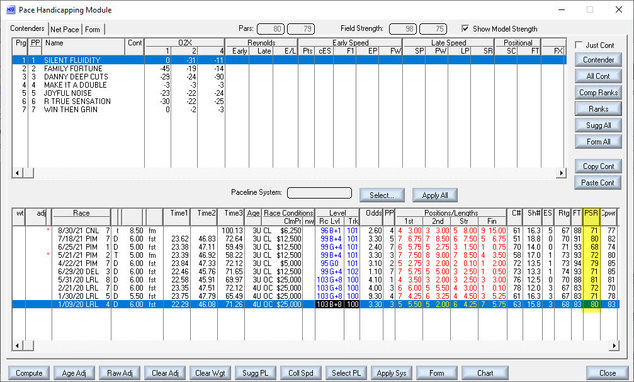
Look down the PPs for each horse at the previous PSRs.
-
HSH: Using PacePSR rating is actually a projection of what each horse is expected to run today. Speed/pace, class, form, jockey and trainer were among the list of factors used to construct the rating. — Tony Kofalt
That is correct.
Of course, at the end of the day, it is just a number, right?
BTW, the biggest challenge with PSR is that it includes a jockey rating. Therefore, technically when there is a jockey change, the rating is invalid.
Still, it is one heck of a number.
We also have what we call cPower - an older version of PSR. Similar, but grandfathered in from before PSR came about in the early 2000s. It has a slightly different flavor - not quite as powerful and correlates with the tote board a little less.
Then there is my own rating - simply called RTG. It is a composite factor because it is made up of 28 other factors and most of those are composites as well. Because only HSH users have RTG, it does not correlate near as much as cPwr or PSR, but still has a hit rate of 30% on the top horse.
None of these produce anything resembling profit and are best used for predicting the final odds, although they can be way off-base at times. I like to say that using our Artificial Morning Line object predicts how the public SHOULD bet.
The other thing that these high-level factors are good for is to pick contenders, which, logically, should correlate closely with the tote.
I know that nobody likes hearing that. They'd rather be able to say, "My top horse in this race paid $42!" But the reality is that if your handicapping is any good, your top horse should be the favorite (or close to it) in almost every race.
Not saying "best bet" or "horse to bet," but if you really thing that all those 8/1 & 12/1 horses are really the best horses in the field, your handicapping is probably not reality-based.
Your thoughts?

Dave Schwartz

Start FollowingSend a Message